
You are moving assets between Ethereum, Arbitrum and Base, and the familiar problem appears at the worst possible moment: the dApp is on one network, your wallet is displaying another, and the confirmation window says little about what the transaction will actually change. A wrong click can approve a contract, swap an unexpected amount or send funds to an address that only looked familiar. This is the practical case for examining Rabby Wallet—not as a magic safety shield, but as a transaction-focused interface for people who use several EVM networks.
For German-speaking DeFi users, the relevant question is less “Is Rabby better than every other wallet?” and more “Which risks does it reduce, and which risks remain mine?” Rabby is a non-custodial wallet developed by DeBank. It stores private keys locally on the user’s device, supports more than 140 EVM-compatible networks, and combines signing with simulations, security warnings and multi-chain navigation. Those features can make complex activity easier to inspect, but convenience should not be confused with independent verification of every protocol or token.
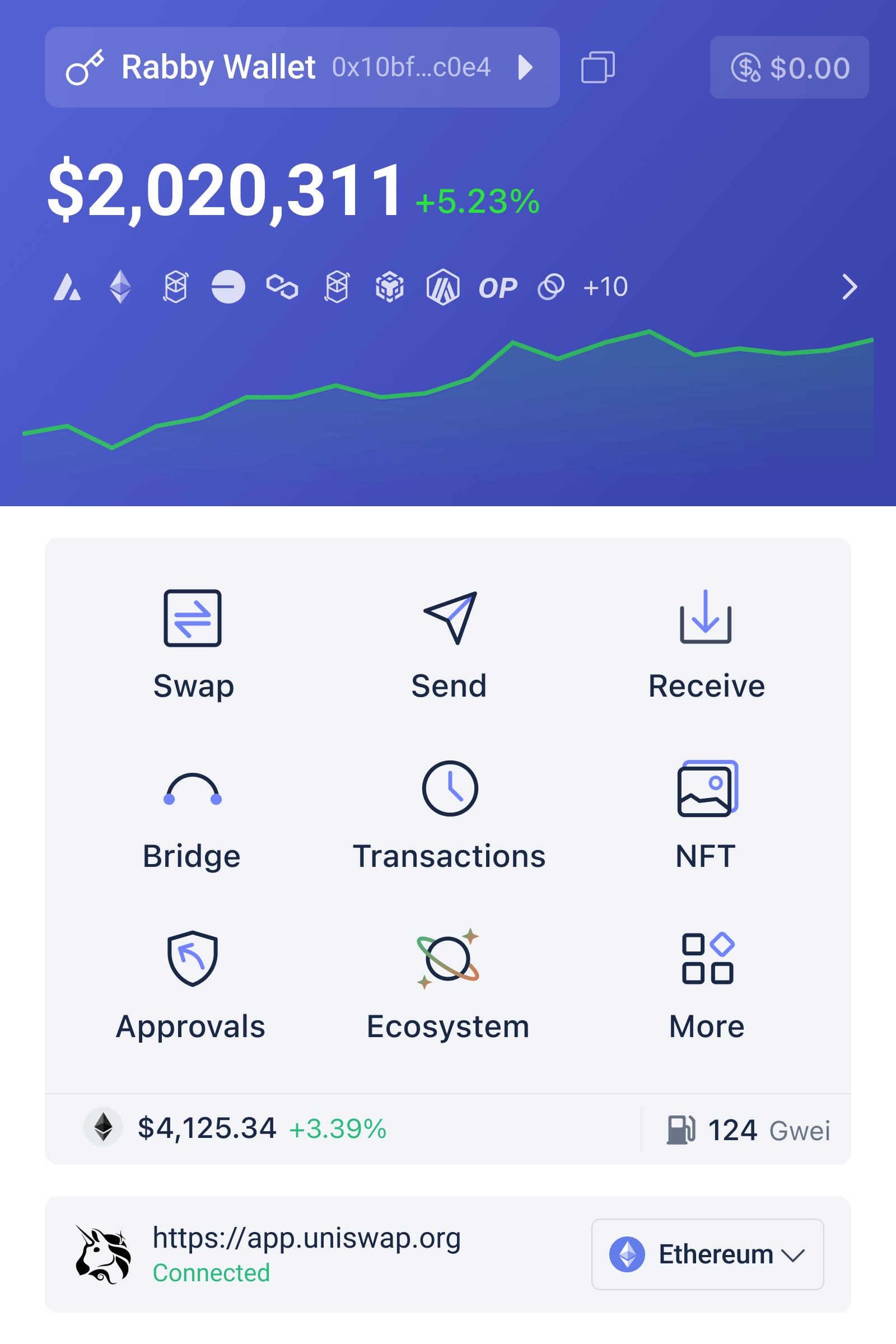
How Rabby’s transaction model differs from a basic wallet
A useful mental model is to treat a wallet as two systems working together. The first is a key manager: it controls access to private keys and signs messages or transactions. The second is an interpretation layer: it helps the user understand what a transaction requests and what may happen after signing. Rabby’s distinguishing emphasis is the second layer. Before confirmation, it simulates the transaction and presents expected changes to token balances. Its security engine also checks contracts and addresses for signals associated with phishing, known exploits and unlimited token approvals.
That distinction matters because blockchain transactions are deliberately low-level. A user may think they are “depositing USDC,” while the underlying action includes a token approval followed by a contract call. An approval can give a protocol permission to spend tokens later; an unlimited approval can expand the consequences of a compromised or malicious contract. A simulation makes the expected outcome more legible, particularly when several calls are bundled together. It does not change the transaction. It improves the quality of the decision made before signing.
Rabby describes itself as independent of its backend in an important operational sense: it does not create or alter the transaction on the user’s behalf, and core signing functions can remain available if Rabby servers are unavailable. This is not the same as saying that every supporting service is irrelevant. RPC providers, dApps, bridge routes and security databases can still affect what the user sees or how quickly information loads. The key insight is narrower and more useful: the wallet interface may assist with analysis, but custody and final authorization remain with the user.
Rabby versus MetaMask: a comparison of priorities
MetaMask remains a widely recognised general-purpose gateway to Ethereum and EVM applications. Rabby positions itself as a direct alternative, but the contrast is best understood as a difference in emphasis rather than a simple winner. MetaMask is familiar, broadly integrated and often the default connection option across Web3. Rabby is designed more explicitly around multi-chain DeFi workflows, with automatic network switching, richer transaction warnings and a review experience that foregrounds balance changes.
For someone who mostly holds assets and occasionally connects to one established application, those differences may be marginal. For a user moving among Ethereum, Polygon, Arbitrum, Optimism, Avalanche, Base and BNB Chain, repeated network selection becomes a source of operational error. Automatic switching can remove unnecessary clicks and reduce confusion when a dApp requests a particular chain. Yet automation introduces its own boundary: a wallet can switch to the requested network correctly while the dApp itself is fraudulent or the requested action is economically unattractive. Fewer manual steps are not automatically safer steps.
Rabby’s broad EVM coverage is therefore most valuable when paired with disciplined review. Before you install the rabby wallet extension, verify that the download comes from an authentic source and create or import a wallet only in an environment you control. Never type a recovery phrase into a website, support chat or “verification” form. Browser extensions are powerful because they can interact directly with dApps; that same privilege makes device hygiene, extension permissions and protection against fake downloads essential.
Where the multi-chain convenience helps—and where it breaks
Rabby integrates bridge protocols such as LI.FI, allowing users to move assets across networks from within the wallet interface. It also offers a swap aggregator that can compare routes involving decentralised exchanges such as Uniswap and 1inch, with the stated aim of finding competitive rates and limiting slippage. These integrations reduce the need to jump between multiple tabs. They also concentrate more decisions inside one interface: route selection, token choice, contract permissions, network selection and fee payment.
That concentration creates a subtle trade-off. A convenient route may involve several contracts and therefore more assumptions than a simple swap on one decentralised exchange. A quoted price can change before inclusion, liquidity can be shallow, and bridge activity introduces additional smart-contract and settlement risk. Simulation may show the expected token result, but it cannot guarantee future market prices, protocol solvency or the absence of a newly discovered vulnerability. For larger transfers, a small test transaction and independent checking of the destination chain remain sensible practices.
The Gas Account feature addresses another common multi-chain friction point: users can pay transaction fees with stablecoins such as USDC across networks even when they lack the native gas token. This is convenient for newcomers and for experienced users managing many chains. Mechanically, however, it does not make fees disappear. The service still needs a way to convert or route value into the network’s fee system, and availability may depend on supported assets, networks and service conditions. Think of it as fee abstraction, not free execution.
Rabby Points, earned through activities such as swaps, gas top-ups or referrals, add a loyalty layer. That may encourage users to explore features, but financial decisions should not be driven by points. A reward programme cannot compensate for poor pricing, unnecessary transactions, bridge exposure or a contract approval you did not intend to grant. In DeFi, the relevant calculation is total risk-adjusted cost—not the existence of a badge or a future reward that is not guaranteed to have monetary value.
Security is a process, not a wallet setting
The strongest practical case for Rabby is its attempt to turn signing into an inspection step. The user can compare the current balance with the simulated post-transaction balance, read warnings and look for unexpected approvals or recipients. This is especially helpful when a transaction contains technical details that a standard confirmation window may not explain clearly. Open-source software, released under the MIT licence, also permits community review of the code, although open source alone does not prove that every version is bug-free or that every dependency and distribution channel is safe.
Hardware-wallet support with Ledger, Trezor and OneKey adds a separate security boundary. A hardware wallet can help keep signing keys isolated from the everyday computer, but it cannot decide whether a malicious transaction is economically sensible. If the user approves a harmful action on the hardware device, the device may faithfully authorise it. The best arrangement is layered: a trusted installation, a protected key, a clear transaction review, careful dApp selection and limited approvals where practical.
For users in Germany, record-keeping is another underappreciated advantage of a deliberate workflow. Keep track of which wallet address interacted with which chain, and preserve transaction records for accounting and tax reporting. The wallet can display activity, but it is not a substitute for personal documentation or professional tax advice. Multi-chain convenience often fragments the transaction history across networks; the more chains you use, the more important it becomes to maintain your own coherent record.
Who should choose Rabby?
Rabby is a strong fit for active EVM users who routinely interact with lending markets, decentralised exchanges, liquidity protocols, bridges and applications deployed across several networks. Its value increases when the user needs to understand a transaction before signing rather than merely click through a familiar prompt. It may be less important for someone who uses a single chain, makes infrequent transfers or prefers a minimal interface with few integrated services.
A reusable decision rule is simple: choose the wallet that makes your most frequent high-risk action easiest to verify. If your main problem is network confusion, automatic switching and broad EVM support matter. If your main concern is unlimited approvals, simulation and warnings matter. If custody risk is the priority, hardware-wallet compatibility matters. If you need cross-chain convenience, bridges and fee abstraction matter—but so does accepting the additional dependency surface. No single feature dominates every use case.
The recent positioning of Rabby as a wallet for Ethereum and EVM activity points toward a broader direction in wallet design: interfaces are becoming transaction interpreters rather than passive key stores. If simulations become more accurate and warnings become more context-aware, users may be able to evaluate contract interactions with less specialised knowledge. The condition is important, though. Better interface information helps only when users pause to read it, and sophisticated attacks can still exploit unfamiliar domains, social pressure or misleading token names.
FAQ
Is Rabby Wallet safe for DeFi?
Rabby can improve transaction awareness through simulations, security warnings, local key storage and hardware-wallet support. It cannot guarantee that a dApp, bridge, token or device is safe. Users still need to verify domains, inspect balance changes, limit approvals where possible and protect the recovery phrase.
Can Rabby replace MetaMask?
For many EVM users, yes. Rabby is positioned as an alternative with a stronger multi-chain and transaction-review focus. The better choice depends on the applications you use, compatibility requirements and whether you prefer integrated DeFi tools or a more established general-purpose workflow.
Does Rabby create or control my transactions?
Rabby is non-custodial: private keys remain locally stored, and the wallet is designed to review and sign rather than take custody of funds. The user still authorises the transaction. Supporting services may affect data presentation or routing, so offline signing capability should not be mistaken for complete independence from every external component.