
Many U.S. traders treat an exchange login as a technicality: enter credentials, complete two-factor authentication, and start trading. That habit masks a deeper truth. OKX is not simply an order book; it is a blended platform that combines a centralized exchange (CEX), a non-custodial Web3 wallet, a DEX aggregator, staking and NFTs, and institutional-grade derivatives. Those differences matter at the mechanics level — how your assets are stored, what risks you accept when you click “deposit,” and which features you can safely use from within a single account. Understanding the mechanisms behind spot trading, margin and futures, and the Web3 integrations will make your login and operational choices purposeful rather than routine.
In this article I will correct one common misconception, explain the practical mechanics behind three core areas (spot, futures/derivatives, and Web3/custody), highlight trade-offs relevant to U.S.-based users, and finish with a short decision framework you can reuse the next time you log into OKX. The goal is not to market the platform but to make your choices defensible and situationally aware.
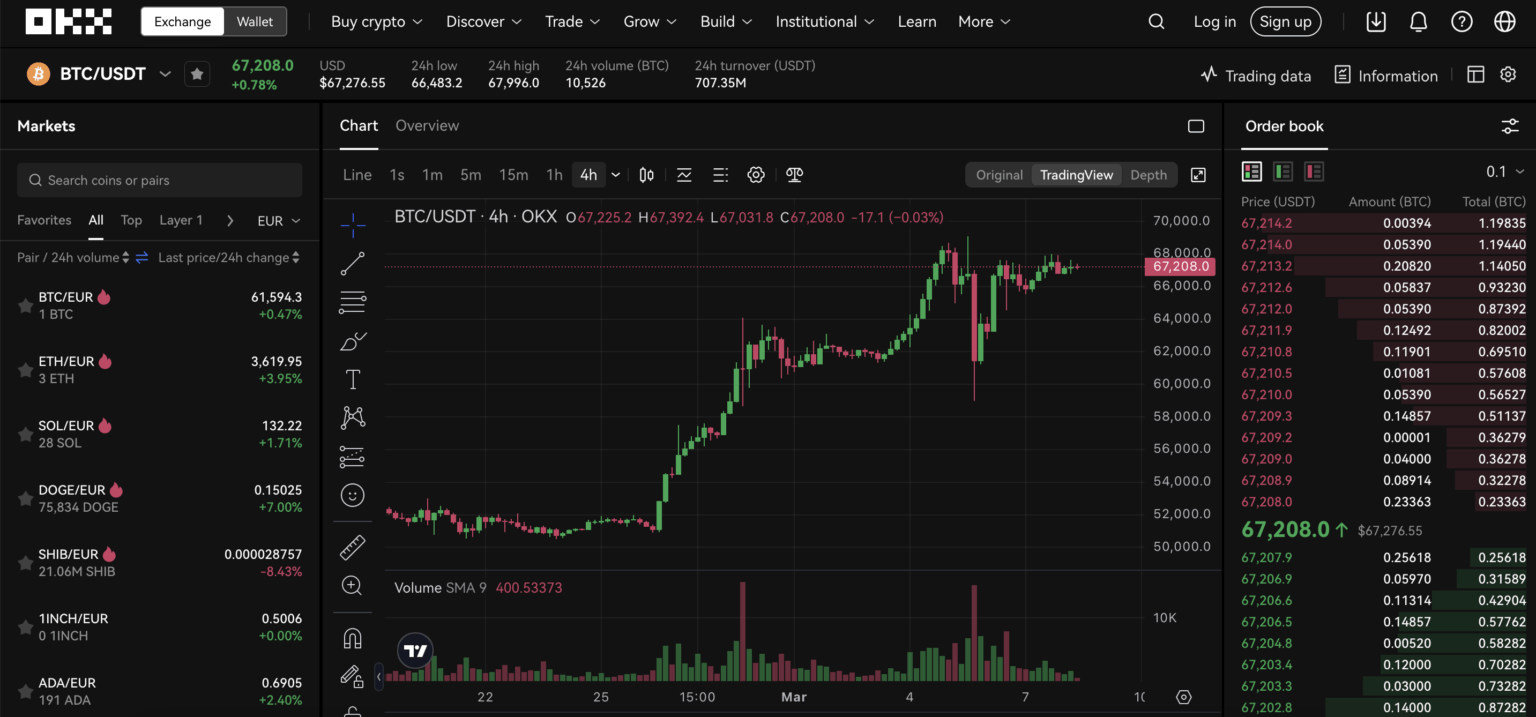
How OKX spot trading actually works (mechanism, limits, and what delisting means)
Spot trading on OKX operates like a conventional exchange order book: buyers and sellers are matched at current market prices. Mechanically, when you place a market or limit order, the exchange updates internal ledgers recording the change in your centralized account balance. For U.S. users the most important practical constraints are KYC and withdrawal governance: you must complete identity verification before full access, and withdrawals are subject to additional checks designed to meet AML controls.
Two non-obvious points matter for strategy. First, the platform supports more than 300 assets, but volume and liquidity vary dramatically. Low-volume tokens can suffer wide spreads and slippage; a limit order is not a guarantee of execution in fast moves. Second, the exchange periodically delists tokens — a recent example is the March 2026 routine removal of several spot pairs including RSS3 and SWEAT — which is an operational risk distinct from price risk. Delisting can force forced conversions, temporary withdrawal windows, or migration offers that affect your ability to exit positions quickly.
Decision-useful heuristic: treat spot holdings on an exchange as operationally liquid only up to the depth you can see in the order book. For assets with shallow order books or that appear on delisting lists, keep smaller on-exchange balances and move long-term holdings to your self-custodial wallet or cold storage where appropriate.
Futures and margin on OKX: leverage mechanics, margin modes, and U.S. considerations
OKX offers margin trading up to 10x and derivatives — perpetual swaps, quarterly futures, and options — with leverage that in some markets can reach 125x depending on the product. Mechanically, futures do not exchange underlying assets; instead they create a leveraged exposure to price movement via margin and maintenance margin requirements. Losses are settled against your margin, and if an account falls below maintenance thresholds, automated liquidations occur to protect counterparty solvency.
Two crucial trade-offs for U.S. traders: leverage amplifies both profit and loss, and the liquidation mechanics can produce cascade effects in thinly traded contracts. Second, cross-margin vs. isolated margin matters. Cross-margin pools your collateral across positions (reducing the chance of idiosyncratic liquidation at the cost of higher systemic exposure), while isolated margin limits exposure to a single position but can lead to faster liquidation of that position unless you proactively top up collateral.
Practical caution: always model worst-case slippage and funding-rate scenarios before opening leveraged positions. For many U.S. retail traders, a more conservative approach is to use limited leverage or only trade perpetuals on the most liquid pairs (BTC, ETH) where bid-ask depth and funding mechanisms are better understood.
Custody, Web3 wallet, and Proof of Reserves: where control and transparency diverge
A central learning point is that OKX operates both custodial accounts and a non-custodial Web3 wallet under the same ecosystem. Custodial accounts benefit from OKX’s cold storage practices — over 95% of assets reportedly held offline using multi-signature approvals — and on-chain Proof of Reserves that offer a level of transparency into backing. That reduces certain exchange insolvency risks, but it does not eliminate operational threats like phishing, targeted account takeovers, or platform-level policy changes (like delistings).
The Web3 wallet is different: you control private keys and seed phrases. That enables direct interaction with DApps, integrated DeFi yield farming, and hardware wallet integrations (Ledger, Trezor). The trade-off is classic custody vs. control: self-custody removes counterparty risk but introduces the possibility of permanent loss if seed phrases or hardware wallets are lost, and smart contract risk when using DeFi protocols. For U.S. users who value regulatory compliance and convenience, a hybrid posture — keep ready-to-trade capital in custodial OKX balances and long-term or DeFi positions in the non-custodial wallet — often balances the two sets of risks.
Where to place assets depends on your use case: active spot day trading needs quick deposit/withdrawal and so benefits from custodial liquidity. Long-term staking, DeFi positions, or NFT ownership often justify the additional responsibility of self-custody.
Staking, yield, and the hidden risks of auto-compounding
OKX supports flexible and fixed-term staking, DeFi yield farming, and auto-compounding features. Mechanistically, staking rewards are typically paid from protocol inflation or fees and auto-compounding reinvests those rewards on your behalf. That increases effective yield but can introduce timing and liquidity constraints — fixed-term lock-ups prevent quick exits and DeFi farms carry smart contract risk.
A nuanced point: the headline APY on an auto-compounding product assumes uninterrupted protocol operation and favorable market conditions. If a protocol undergoes an exploit, or if tokenomics change, realized returns can diverge sharply from advertised rates. For U.S. participants, check whether a staking product is native to a chain you trust and whether withdrawal windows align with your liquidity needs.
How login and account protection should change after reading this
Login is the hinge where many of the above mechanisms converge. Treat the OKX login not as a simple technical step but as an operational control point. Use hardware 2FA where supported, prefer biometric login on your mobile device only if the device is secured, and enable withdrawal whitelists so that assets cannot be drained to new addresses without confirmation. Remember that AI-driven threat detection reduces but does not remove targeted social engineering and SIM-swap risks common in the U.S.
For traders planning to switch between spot and futures, minimize surprises by maintaining a buffer margin and by understanding transfer times between custodial and non-custodial pockets. If you intend to use the DEX aggregator or bridge assets cross-chain, treat those flows as separate risk events: smart contract and bridge risk are distinct from custodial exchange risk and should influence how much capital you route through those paths.
Useful login checklist: complete KYC ahead of time, enroll a secure 2FA method, link a hardware wallet if you will use the Web3 vault, set withdrawal whitelists, and keep an off-exchange copy of important receipts and seed phrases (secured physically, not digitally). For step-by-step login help and navigation relevant to U.S. traders, see this resource: https://sites.google.com/cryptowalletextensionus.com/okx-login-web/.
Comparing OKX with two alternatives (trade-offs at a glance)
Consider three archetypes: OKX (multi-function CEX + Web3), a pure CEX with limited Web3 features, and a non-custodial-only wallet. OKX trades off slightly higher centralized-control complexity for integrated services: you can move between spot, margin, DeFi, and NFT markets without leaving the UI. A pure CEX simplifies custody and compliance but often forces external bridging for DeFi use. A non-custodial wallet gives ultimate control but lacks liquidity, on-ramp convenience, and institutional-grade derivatives. Your choice depends on which of the following you prioritize: convenience and breadth (OKX), simplicity and narrow focus (pure CEX), or maximal self-sovereignty (non-custodial).
For most U.S. retail traders who engage in both spot trading and occasional DeFi or NFT activity, OKX’s hybrid model is defensible — provided you internalize the multi-vector risks described above and partition assets accordingly.
What to watch next (near-term signals and conditional scenarios)
Monitor three near-term signals that will change the calculus: (1) regulatory guidance in the U.S. about derivatives and custody, which could force product adjustments; (2) liquidity migrations across exchanges that make certain spot pairs fragile and more likely to be delisted; and (3) DeFi security incidents that shift the relative appeal of custodial yield vs. self-custodial farming. Any one of these could alter where you keep assets or how aggressively you use margin.
Conditional scenario: if regulatory pressure tightens on U.S. derivatives offerings, exchanges may limit leverage or restrict certain instruments, raising funding costs and reducing profit potential for high-frequency strategies. Conversely, improved on-chain transparency or better insurance mechanisms could make centralized custody more attractive again.
FAQ
Q: Is it safer to keep all my crypto in the OKX custodial account or in the non-custodial wallet?
A: There is no one-size-fits-all answer. Custodial accounts benefit from cold storage, Proof of Reserves, and professional security operations but carry counterparty and policy risks. Non-custodial wallets give you control but expose you to seed-phrase loss and smart contract risk. A hybrid approach — operational capital on-exchange, long-term holdings in self-custody — balances those trade-offs.
Q: How should U.S. traders think about leverage on OKX?
A: Leverage magnifies both gains and losses and invites liquidation risk. Use isolated margin to limit exposure to any single position, keep a margin buffer, and favor the most liquid instruments (BTC, ETH) for leveraged trades. Model worst-case slippage and remember that funding rates and volatility spikes can flip profit expectations quickly.
Q: What does a delisting mean for my spot holdings?
A: Delisting may require you to withdraw the asset, convert to another token, or accept a migration proposal. It can temporarily reduce liquidity and raise exit costs. For thinly traded tokens, holding off-exchange until you have a clear plan reduces operational risk.
Q: Are OKX’s Proof of Reserves and cold storage guarantees absolute?
A: Proof of Reserves increases transparency by showing on-chain backing, and cold storage mitigates online theft. Neither eliminates all risk: on-chain proofs do not prevent operational errors, regulatory seizure, or social-engineering fraud against individual accounts.